She Takes the Helm: Why Female Pirate Characters Are Having Their Best Era Yet
Let's be honest about where we were for a long time. Female pirates in entertainment existed primarily in one of three configurations: the captive who needed rescuing, the love interest who happened to be good with a blade, or the mysterious seductress whose entire character arc revolved around a male protagonist's feelings about her. Occasionally, if the writers were feeling adventurous, she got to stab someone and then had an emotion about it.
That era is not entirely over — let's not kid ourselves — but something has genuinely shifted. Across film, television, and gaming, female pirate characters are arriving with more complexity, more agency, and more genuine narrative weight than at any point in the history of the genre. And audiences are responding with the kind of enthusiasm that makes studios and developers pay attention.
So what changed? And why now? Let's dig in.
The Historical Irony That Entertainment Finally Noticed
Here's a fun piece of context that the pirate genre spent decades largely ignoring: real female pirates were genuinely terrifying. Anne Bonny and Mary Read weren't footnotes in maritime history — they were documented as among the most ferocious fighters on their ship, with accounts suggesting they kept fighting when most of the male crew had surrendered. Ching Shih commanded a fleet of over 1,800 vessels at her peak, making her one of the most powerful pirates in recorded history, male or female, full stop.
The historical record was always there. Entertainment just wasn't particularly interested in it for a long time. The pirate genre had calcified around certain conventions — the roguish male captain, the code, the crew of lovable misfits — and female characters were fitted into that structure in supporting roles rather than being allowed to reshape it.
Modern adaptations have started actually doing their homework, and the results have been revelatory. When you build a female pirate character on a foundation of real history rather than fantasy convenience, you get something richer and stranger and more compelling than the alternatives. You get women who don't need the story to bend over backwards to justify their presence, because the historical record already confirms: they were there, they were formidable, and the genre was impoverished by leaving them out.
What "Agency" Actually Looks Like on Screen
The word "agency" gets thrown around a lot in conversations about female character representation, and it's worth being specific about what it means in the context of pirate fiction — because this genre has some particular failure modes.
A female pirate character with genuine agency isn't just one who fights well or gives orders. Those are table stakes. Real agency means her motivations exist independently of the male characters around her. It means her backstory is her own, not a trauma designed to explain why she's attached herself to a male protagonist. It means she makes choices — including bad ones — that have consequences the story takes seriously. It means she can be wrong, and petty, and brilliant, and ruthless, without the narrative rushing to soften those edges.
The female pirate characters that have landed hardest with audiences in recent years share this quality. They are not aspirational in the sense of being perfect. They're aspirational in the sense of being real — complicated, motivated by specific desires, capable of genuine menace and genuine warmth, and occupying the center of their own stories rather than orbiting someone else's.
This sounds like a low bar. In practice, for a very long time, it was a bar that a significant chunk of the genre failed to clear.
Gaming's Quiet Revolution
While film and television have gotten most of the cultural conversation around female pirate representation, gaming has been doing genuinely interesting work in this space — sometimes more interesting, because the interactive format creates possibilities that passive media can't replicate.
When you play as a female pirate captain, the experience of agency becomes literal. You're not watching someone else make decisions — you're making them. The character's competence is your competence. Her victories belong to you. This creates a different and arguably more powerful relationship between audience and character, and it's one that the gaming industry has been slowly but meaningfully expanding access to.
Customizable protagonists in pirate games have opened up space for players who previously had to project themselves onto characters who didn't look like them. Purpose-built female pirate leads have demonstrated that these characters can anchor major releases without any of the hand-wringing that used to accompany such decisions. The market has spoken, and what it said was: more of this, please.
Indie games have been particularly adventurous here, building female pirate protagonists with genuinely unusual narrative angles — captains dealing with grief, with legacy, with the specific complications of commanding loyalty in a world designed to deny them authority. The constraints of smaller budgets have, paradoxically, sometimes produced more psychologically interesting characters than their big-budget counterparts.
The Costume Problem (And How Some Productions Are Solving It)
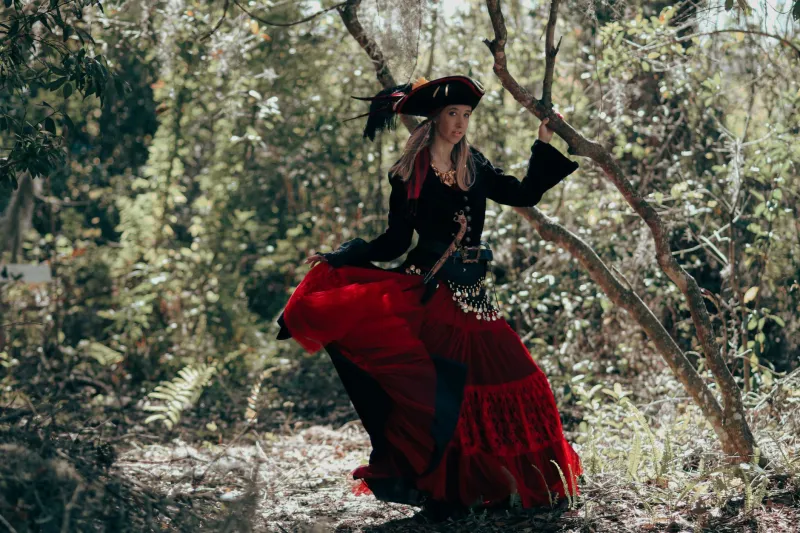
Look, we have to talk about it. The history of female pirate costume design in entertainment is a history of decisions that prioritized a certain kind of visual appeal over anything approaching practicality or dignity. The impractical corset. The conveniently torn blouse. The general sense that the character's outfit was designed by someone whose primary concern was not "what would help this person survive a naval battle."
This has been changing, and the change is more significant than it might appear. When a female pirate character is dressed like someone who actually has to fight and work and survive at sea — when her costume communicates competence and history rather than decorative function — it changes how the audience reads her. It signals that the production takes her seriously. It's a visual statement of intent that audiences have learned to notice and respond to.
The best recent productions have understood that authentic, functional costume design for female pirates isn't just a political choice — it's a storytelling choice. It builds credibility. It makes the character's physical competence legible. It respects the audience enough to say: we're not asking you to suspend disbelief about whether this person could actually do what we're claiming she can do.
Why This Moment Feels Different
The rising prominence of complex female pirate characters isn't happening in a vacuum. It's part of a broader cultural appetite for stories that expand who gets to be legendary — who gets the origin story, the mythology, the franchise, the action figure.
But pirate fiction has a specific quality that makes it particularly well-suited to this expansion: the genre has always been about people who operate outside the rules. Pirates reject the established order. They build alternative power structures. They claim authority that the dominant world refuses to grant them. That's an inherently resonant framework for stories about women who refuse to accept the limits placed on them, and the genre is finally, properly, exploiting that resonance.
The captains sailing these stories forward aren't doing it despite the pirate tradition. They're doing it because of it. The Jolly Roger was always a flag for people the world tried to leave behind. It's about time more of them got to fly it.